
The Laws of Human Nature
by Robert Greene
About This Book
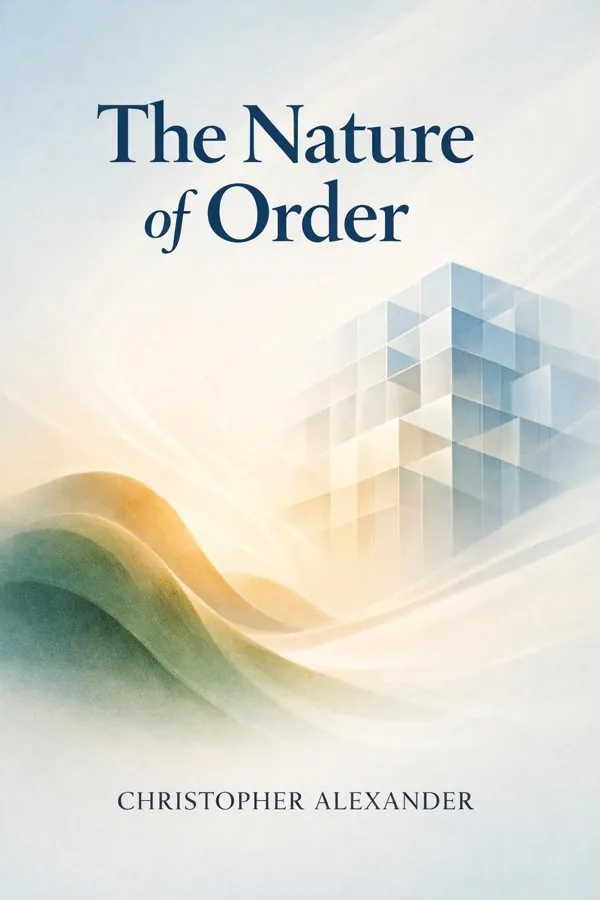
The Nature of Order is a four-volume work by architect and design theorist Christopher Alexander, exploring the fundamental principles of architecture, design, and the nature of living structure. Across its volumes—The Phenomenon of Life, The Process of Creating Life, A Vision of a Living World, and The Luminous Ground—Alexander presents a unified theory of order that connects the built environment with the natural world, proposing that beauty and life emerge from deep structural coherence.
The Nature of Order: An Essay on the Art of Building and the Nature of the Universe
The Nature of Order is a four-volume work by architect and design theorist Christopher Alexander, exploring the fundamental principles of architecture, design, and the nature of living structure. Across its volumes—The Phenomenon of Life, The Process of Creating Life, A Vision of a Living World, and The Luminous Ground—Alexander presents a unified theory of order that connects the built environment with the natural world, proposing that beauty and life emerge from deep structural coherence.
Want the full summary?
Get instant access to this book summary and 500K+ more with Fizz Moment.
Get Free SummaryAvailable on App Store • Free to download
Key Chapters
Wholeness and the Fifteen Properties of Living Structure
At the core of my inquiry is what I call *wholeness*. Wholeness is not a metaphor or a mystical term; it is a structural and measurable quality of the world. You can perceive it directly whenever something feels deeply alive. Imagine a natural pond surrounded by flowers—there is a sense of coherence, a feeling that every stone and petal belongs. Contrast that with a sterile courtyard paved with concrete, where the elements conflict instead of supporting one another. The difference lies in the degree of wholeness.
Wholeness reveals itself through fifteen geometric properties that recur in nature and in all things that possess life—levels of scale, strong centers, boundaries, alternating repetition, positive space, local symmetries, and others. Each property strengthens the coherence of parts within the whole. These are not aesthetic tricks; they are the fundamental processes through which the universe organizes itself, visible from the smallest atom to the grandest city.
To understand them, we must stop thinking of form as something imposed from outside and begin to see it as something that unfolds from within. When we create with awareness of these properties, beauty is not decoration—it is the natural outcome of living order. The task of the architect or maker is to recognize the centers that emerge in space, to nurture them as one would nurture living beings. Each boundary, each gradient, each echoing proportion contributes to a deeper coherence that can actually be felt in the human heart.
This approach reveals that feelings are diagnostic instruments. When a building feels alive, it is because the geometric coherence resonates with our own inner structure. When it feels dead, something has fractured that resonance. Thus, life in form and life in ourselves are reflections of one continuum—the same wholeness that binds the entire universe together.
The Generative Process: How Living Structure Emerges
Recognizing wholeness is only the beginning. The deeper question is: how does wholeness come into being? Through years of observation I came to understand that living structure cannot be produced by design templates or master plans. It grows through a *generative process*, a sequence of small, adaptive steps that unfold naturally from what already exists.
Consider how a seed becomes a tree. Each new part appears in response to local conditions, extending the wholeness that preceded it. The same principle applies to building. A living environment arises when each act of construction deepens the coherence of what is already there. I call this the process of unfolding—not imposing a vision, but letting form arise in sympathy with its context.
This generative way of creating requires patience and a shift in our consciousness. We must look not at projects as products but as living processes. In traditional villages, builders did this instinctively. They added a doorway where people naturally passed, extended a path where feet pressed the earth, adjusted a roof to catch the light just so. Each adaptation was guided by feeling, and feeling served as a measure of life.
To design in this way today is to rejoin the creative rhythm of the world. The architect becomes a participant rather than a controller. Decisions emerge from observing, sensing, responding, always asking: does this step increase wholeness? Over time, small coherent acts compound into profound beauty. When this happens, the building is not only functional—it sings with life.
The Designer’s Role and Methods for Creating Living Environments
Explore this chapter in the FizzRead app.
The Luminous Ground: The Spiritual Dimension of Order
Explore this chapter in the FizzRead app.
Implications for Science, Art, and Society
Explore this chapter in the FizzRead app.
All Chapters in The Laws of Human Nature
About the Author
Robert Greene
Christopher Alexander (1936–2022) was a British-American architect and design theorist known for his influential works on architecture and urban design. He taught at the University of California, Berkeley, and authored seminal books such as A Pattern Language and The Timeless Way of Building, which have profoundly impacted architecture, software design, and systems thinking.
Frequently Asked Questions about The Laws of Human Nature
The Nature of Order is a four-volume work by architect and design theorist Christopher Alexander, exploring the fundamental principles of architecture, design, and the nature of living structure. Across its volumes—The Phenomenon of Life, The Process of Creating Life, A Vision of a Living World, and The Luminous Ground—Alexander presents a unified theory of order that connects the built environment with the natural world, proposing that beauty and life emerge from deep structural coherence.
You Might Also Like




Ready to read The Laws of Human Nature?
Get the full summary and 500K+ more books with Fizz Moment.