
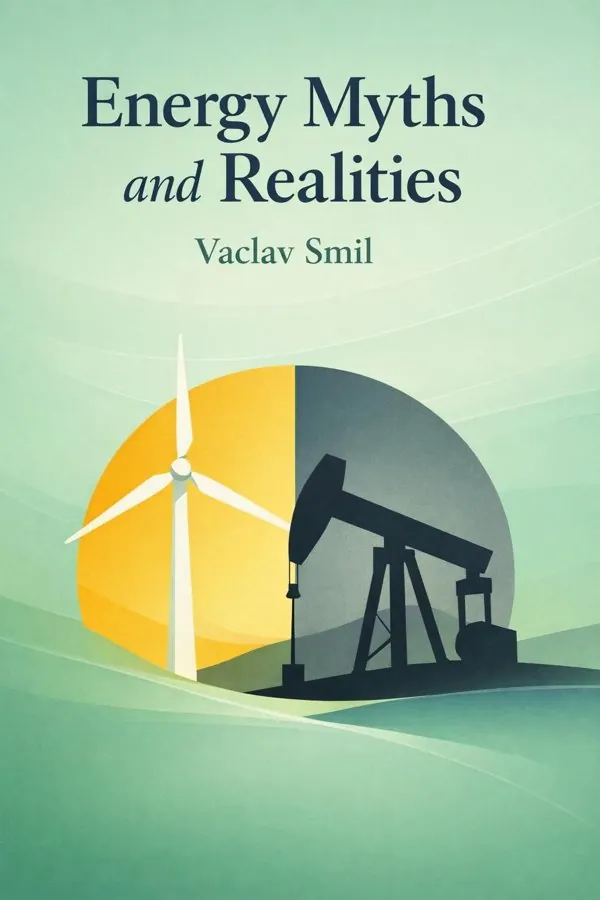
Good Energy
by Casey Means
About This Book
This book examines common misconceptions about energy sources, consumption, and sustainability. Vaclav Smil uses scientific evidence to challenge popular beliefs about renewable energy, fossil fuels, and technological transitions, offering a realistic perspective on what can and cannot be achieved in the global energy landscape.
Energy Myths and Realities: Bringing Science to the Energy Policy Debate
This book examines common misconceptions about energy sources, consumption, and sustainability. Vaclav Smil uses scientific evidence to challenge popular beliefs about renewable energy, fossil fuels, and technological transitions, offering a realistic perspective on what can and cannot be achieved in the global energy landscape.
Want the full summary?
Get instant access to this book summary and 500K+ more with Fizz Moment.
Get Free SummaryAvailable on App Store • Free to download
Key Chapters
Defining Energy and Its Role
To discuss energy rationally, we must begin with precision. Energy is not an abstract symbol of progress or sustainability; it is a measurable quantity—the capacity to perform work. Power measures the rate at which that capacity is used. Efficiency relates output to input, determining how much useful work we get from a given flow of energy. These distinctions, although elementary, are often blurred in public discourse. People conflate energy with electricity, treat percentage efficiencies as magic levers, and neglect the physical limits determined by the laws of thermodynamics.
Every civilization rests on its energy foundations. Our economics, food systems, technologies, and comforts are built upon the flows and stocks of usable energy. These flows are constrained by the physics of conversion and by the infrastructure that enables it. Energy transitions are not merely a matter of choosing to substitute one fuel for another. They require vast reconstructions of entire systems—power plants, transport networks, supply chains. The scale alone is daunting. Humanity currently consumes hundreds of exajoules per year, each joule representing a unit of work that must be generated, transported, and transformed.
I emphasize in the book that we must always think in quantitative terms. A shift to renewable energy means not only deploying new technologies but replacing an immense fossil-based infrastructure built over the past century. That substitution cannot happen overnight, because physical, economic, and behavioral inertia governs it. Thus, before talking about transitions or revolutions, we need humility regarding the basic laws of energy itself.
Historical Energy Transitions
History is the best teacher when it comes to energy transitions. Humanity began with biomass—wood, crop residues, and animal energy. These sources sustained preindustrial societies for millennia but had severe limitations: low energy density and poor conversion efficiency. The move to coal during the Industrial Revolution was revolutionary not because coal was cleaner or ethically better, but because it offered higher energy concentration, enabling the mechanization and expansion of industry.
That transition, however, did not occur suddenly. Britain’s dominance took about a century to consolidate coal’s role. Oil arrived later, driven by transport and chemicals, yet even then, it took decades for infrastructures and habits to align with petroleum. The same gradualism marked the rise of natural gas. Each shift was a complex interplay of technical innovation, market forces, and social adaptation.
I highlight in the book that there are no historical precedents for a global energy transition happening within a generation. Even under optimal circumstances, replacing a significant share of global primary energy supply requires half a century or more. Acknowledging that pattern allows us to manage expectations. It doesn’t negate progress—it frames it realistically. The lessons of history reveal that enthusiasm cannot override physical and economic realities. If we forget that, we risk planning based on illusion rather than experience.
Myth of Rapid Energy Transformation
Explore this chapter in the FizzRead app.
Renewable Energy Realities
Explore this chapter in the FizzRead app.
Fossil Fuels and Their Persistence
Explore this chapter in the FizzRead app.
Nuclear Energy
Explore this chapter in the FizzRead app.
Energy Efficiency and Conservation
Explore this chapter in the FizzRead app.
Technological Optimism and Its Limits
Explore this chapter in the FizzRead app.
Environmental and Economic Interactions
Explore this chapter in the FizzRead app.
Policy Implications
Explore this chapter in the FizzRead app.
All Chapters in Good Energy
About the Author
Casey Means
Vaclav Smil is a Czech-Canadian scientist and policy analyst known for his interdisciplinary research on energy, environment, food production, and technological innovation. He is a Distinguished Professor Emeritus at the University of Manitoba and has authored numerous influential works on energy and sustainability.
Frequently Asked Questions about Good Energy
This book examines common misconceptions about energy sources, consumption, and sustainability. Vaclav Smil uses scientific evidence to challenge popular beliefs about renewable energy, fossil fuels, and technological transitions, offering a realistic perspective on what can and cannot be achieved in the global energy landscape.
You Might Also Like

Surrounded by Idiots
Thomas Erikson

When Breath Becomes Air
Paul Kalanithi

The Mountain Is You
Brianna Wiest

The Way of the Superior Man
David Deida

Fast Like a Girl
Dr. Mindy Pelz

Men Are from Mars, Women Are from Venus
John Gray
Ready to read Good Energy?
Get the full summary and 500K+ more books with Fizz Moment.