
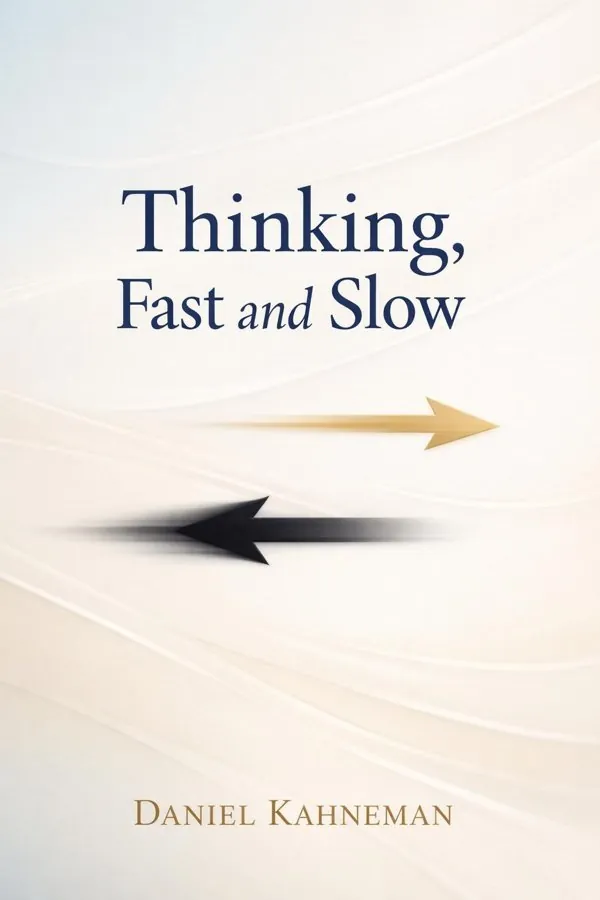
Thinking, Fast and Slow
by Daniel Kahneman
About This Book
In this landmark book, Nobel laureate Daniel Kahneman presents decades of research on how humans think, revealing the dual systems that drive our judgments and decisions: the fast, intuitive, and emotional System 1, and the slow, deliberate, and logical System 2. Through engaging examples and experiments, Kahneman explores cognitive biases, heuristics, and the limits of rationality, offering profound insights into how we make choices in everyday life and professional contexts.
Thinking, Fast and Slow
In this landmark book, Nobel laureate Daniel Kahneman presents decades of research on how humans think, revealing the dual systems that drive our judgments and decisions: the fast, intuitive, and emotional System 1, and the slow, deliberate, and logical System 2. Through engaging examples and experiments, Kahneman explores cognitive biases, heuristics, and the limits of rationality, offering profound insights into how we make choices in everyday life and professional contexts.
Want the full summary?
Get instant access to this book summary and 500K+ more with Fizz Moment.
Get Free SummaryAvailable on App Store • Free to download
Key Chapters
The Two Systems of Thought
Our minds work through two interacting systems. System 1 is automatic, fast, and emotional; System 2 is controlled, slow, and logical. System 1 suggests interpretations and solutions; System 2 monitors, corrects, and sometimes overrides. But the balance is unequal—System 1 is effortlessly active, while System 2 is lazy, conserving mental energy unless enforced. You might imagine the two as a skilled but impulsive assistant and a supervisor who loves efficiency too much to double-check everything.
System 1 produces the spontaneous judgments that feel right. When you meet someone who smiles warmly, System 1 instantly labels the person trustworthy. When you drive on a familiar road, System 1 takes over almost entirely. Yet much of what we call intuition is the product of past exposure and automatic pattern recognition. The system thrives on coherence—it weaves a story linking every piece of data into a consistent narrative. That story often feels true precisely because it feels coherent.
System 2 is the mind’s guardian of rationality. It is slow because it demands focused attention. When we calculate, compare alternatives, or question an assumption, System 2 is in charge. But it tires easily. Cognitive effort is metabolically expensive; we unconsciously avoid it whenever possible. This aversion to mental effort is what allows System 1 to dominate most of our decisions. It gives us fluency, but it also generates biases—for System 1 jumps to conclusions even when the evidence is weak.
Once you grasp this dynamic, you begin to see how decisions are made behind the curtain. You notice your intuitive reactions as products of System 1—quick, confident, but not always reliable. You learn to sense the threshold where System 2 must intervene. This awareness is not natural; it is cultivated. That cultivation is the first step toward more careful thinking.
Heuristics and Biases: The Architecture of Errors
Our cognitive machinery developed to manage complexity through shortcuts—mental rules of thumb called heuristics. Heuristics simplify judgment, but they also deliver predictable errors. One is the availability heuristic: when we assess probability, we judge based on how easily examples come to mind. Events that are recent, vivid, or emotionally charged feel more common than they are. That is why people fear plane crashes more than car accidents—they can recall plane disasters more easily.
Another is the representativeness heuristic. When we judge whether someone belongs to a category, we look for resemblance rather than probability. If told that Linda is outspoken and concerned with social justice, most people will say she is a bank teller active in the feminist movement. But statistically, she is more likely to be simply a bank teller. The description triggers resemblance, while the logical structure of probability disappears.
These systematic biases are not mere mistakes—they illuminate how the mind aims for coherence, not logic. The intuitive mind substitutes one question for another: instead of 'What is the probability that Linda is a bank teller?' it answers 'How similar is Linda to my image of a feminist?'. This substitution feels effortless, which is why we rarely notice it. But the result is flawed reasoning that shapes public opinion, risk perception, and even economic behavior.
Reflecting on these patterns teaches humility. The errors are not signs of stupidity—they are echoes of an intelligent system optimized for speed and survival. Yet in modern contexts, where precision matters more than immediacy, these tendencies mislead. Understanding them allows us to anticipate failure points in our own judgment, and to invite our slower, skeptical system to review what intuition produces so easily.
All Chapters in Thinking, Fast and Slow
About the Author
Daniel Kahneman
Daniel Kahneman (1934–2024) was an Israeli-American psychologist and Nobel laureate in Economic Sciences, recognized for his pioneering work on the psychology of judgment, decision-making, and behavioral economics. He was a professor emeritus at Princeton University and co-founder of the field of behavioral economics.
Frequently Asked Questions about Thinking, Fast and Slow
In this landmark book, Nobel laureate Daniel Kahneman presents decades of research on how humans think, revealing the dual systems that drive our judgments and decisions: the fast, intuitive, and emotional System 1, and the slow, deliberate, and logical System 2. Through engaging examples and experiments, Kahneman explores cognitive biases, heuristics, and the limits of rationality, offering profound insights into how we make choices in everyday life and professional contexts.
You Might Also Like





Ready to read Thinking, Fast and Slow?
Get the full summary and 500K+ more books with Fizz Moment.