
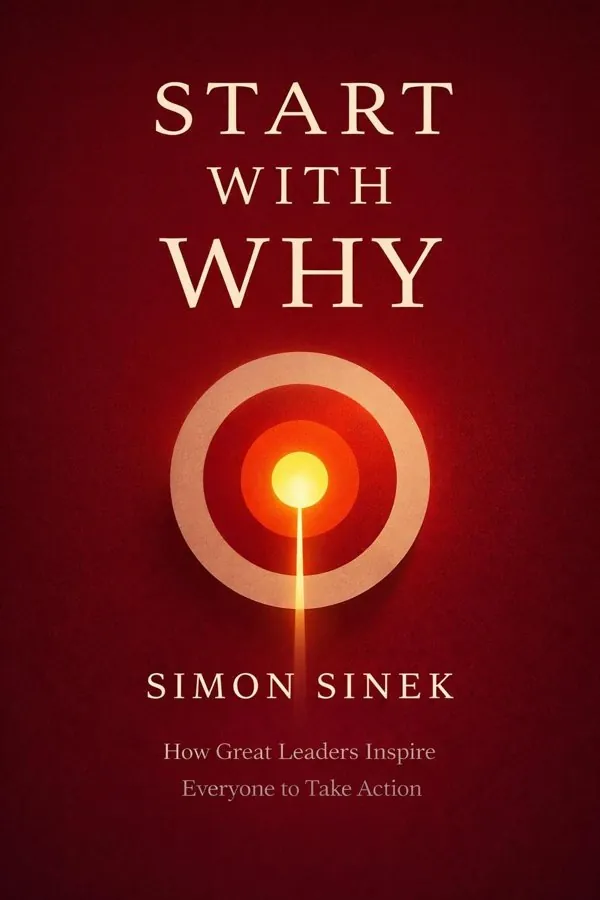
Start With Why
by Simon Sinek
About This Book
Start With Why explores how leaders and organizations can inspire cooperation, trust, and change by focusing on the purpose behind their actions. Simon Sinek argues that successful individuals and companies communicate from the inside out—starting with 'why'—to connect deeply with others and drive lasting success.
Start With Why: How Great Leaders Inspire Everyone to Take Action
Start With Why explores how leaders and organizations can inspire cooperation, trust, and change by focusing on the purpose behind their actions. Simon Sinek argues that successful individuals and companies communicate from the inside out—starting with 'why'—to connect deeply with others and drive lasting success.
Want the full summary?
Get instant access to this book summary and 500K+ more with Fizz Moment.
Get Free SummaryAvailable on App Store • Free to download
Key Chapters
The Golden Circle: Why, How, and What
Imagine three concentric circles. At the center sits the word ‘WHY’. Surrounding it is ‘HOW’, and wrapping both is ‘WHAT’. This is what I call the Golden Circle — a simple yet profound framework that mirrors how inspired leaders and organizations think, act, and communicate.
Every company on the planet knows what they do: the products they sell, the services they offer. Some also know how they do it — their differentiating process or unique selling proposition. But only a handful can clearly articulate *why* they do what they do. ‘Why’ doesn’t mean ‘to make money’ — that’s a result. ‘Why’ means the purpose, cause, or belief that drives you. It’s the reason your organization exists beyond profit.
Inspired leaders and companies operate from the inside out. They start with ‘why’. Apple, for instance, isn’t in the business of making computers. Its ‘why’ is to challenge the status quo and empower individuals to think differently. That belief manifests through ‘how’ — elegant design, user-friendly interfaces — and culminates in ‘what’: computers, phones, and products that embody that belief. Apple’s clarity of purpose is what makes people line up for new releases, not just buy commodities.
Most companies do the opposite. They communicate from the outside in: starting with ‘what’, moving to ‘how’, and rarely articulating ‘why’. This approach may convince people to buy once, but it fails to build loyalty or inspire engagement. When you lead with ‘why’, you tap into something far deeper — the limbic system of the human brain, the part responsible for feelings, decision-making, and trust. Logic lives in the neocortex; belief lives in the limbic brain. People may rationalize with facts, but they act on emotion.
The Golden Circle isn’t a marketing strategy; it’s a natural law of human behavior. When organizations align their actions with their purpose, they produce coherence. The ‘why’ defines the vision, the ‘how’ defines the values, and the ‘what’ becomes the proof. Lose your ‘why’, and you lose direction. Uphold it, and you build an enduring legacy driven not by manipulation but by meaning.
Manipulation versus Inspiration
In the marketplace, manipulation is everywhere. Discounts, fear-based messaging, peer pressure, aspirational advertising — all of these may work in the short run, but they never create loyalty. They push people to act for external reasons, not internal belief. It’s why so many organizations struggle with retention, trust, and morale. Manipulation can move a product; it cannot move a soul.
Inspiration, by contrast, builds relationships grounded in belief. When people buy into your ‘why’, they aren’t customers; they’re believers. They become ambassadors for your cause because they feel part of something larger. Think of Martin Luther King Jr. He didn’t stand before a crowd and outline a ten-step plan for civil rights legislation. He stood and said, ‘I have a dream.’ He spoke of a vision so emotionally compelling that millions took ownership of it. He led with ‘why’. The dream wasn’t his alone — it became everyone’s.
The difference between manipulation and inspiration is the difference between transactions and transformation. Manipulation leads to pressure and fatigue; inspiration leads to commitment and resilience. This distinction applies internally, too. Employees manipulated by fear or incentives will comply, but they won’t give their creativity or heart. Employees inspired by purpose will innovate, collaborate, and endure. When your organization’s decisions and actions consistently reflect your 'why', you create an environment where trust flourishes naturally.
Inspiration isn’t about charisma or grand gestures. It’s about clarity and consistency. When people see a leader whose words and actions align with a purpose they believe in, they follow with loyalty, not obligation. That’s the essence of leadership — not authority or control, but belief and example.
All Chapters in Start With Why
About the Author
Simon Sinek
Simon Sinek is a British-American author, motivational speaker, and organizational consultant known for his work on leadership and inspiration. He gained international recognition through his TED Talk 'How Great Leaders Inspire Action' and his bestselling books on purpose-driven leadership.
Frequently Asked Questions about Start With Why
Start With Why explores how leaders and organizations can inspire cooperation, trust, and change by focusing on the purpose behind their actions. Simon Sinek argues that successful individuals and companies communicate from the inside out—starting with 'why'—to connect deeply with others and drive lasting success.
You Might Also Like


Ready to read Start With Why?
Get the full summary and 500K+ more books with Fizz Moment.