
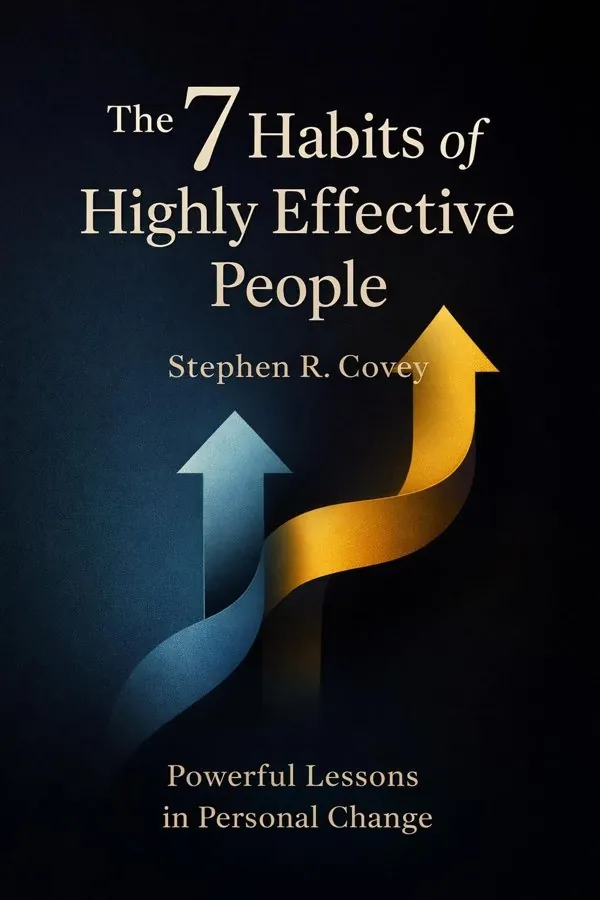
The 7 Habits of Highly Effective People
by Stephen R. Covey
About This Book
This influential self-help book by Stephen R. Covey presents a principle-centered approach for solving personal and professional problems. Covey outlines seven habits that guide readers toward effectiveness through integrity, fairness, and human dignity. The book emphasizes proactive behavior, goal setting, prioritization, and synergy as keys to success and fulfillment.
The 7 Habits of Highly Effective People: Powerful Lessons in Personal Change
This influential self-help book by Stephen R. Covey presents a principle-centered approach for solving personal and professional problems. Covey outlines seven habits that guide readers toward effectiveness through integrity, fairness, and human dignity. The book emphasizes proactive behavior, goal setting, prioritization, and synergy as keys to success and fulfillment.
Want the full summary?
Get instant access to this book summary and 500K+ more with Fizz Moment.
Get Free SummaryAvailable on App Store • Free to download
Key Chapters
Habit 1: Be Proactive — Owning the Freedom to Choose
When I speak of being proactive, I don’t mean being constantly energetic or outwardly enthusiastic. Rather, it’s about grasping one profound truth: among all human endowments, the most unique is the ability to choose our response. Animals act largely by instinct, but between stimulus and response, humans possess a space—a freedom to decide how to act. In that space lies both our free will and our accountability.
Most people define themselves by external circumstances: bad weather ruins their mood, an unfair boss kills their motivation, or family stress makes them unfocused. Highly effective people flip this pattern. They do not let situations dictate their emotions or other people’s actions determine their attitudes. They understand that responsibility itself means response-ability—the ability to choose their response. True proactivity begins within, not from outside encouragement.
Proactive individuals are clear about their sphere of influence. They invest energy in what they can control—attitude, competence, communication, and learning—rather than wasting it on things they cannot, such as politics or the weather. As they focus on what’s controllable, their influence naturally expands. Proactivity is not blind optimism; it’s a form of practical leadership. It empowers you to stop merely reacting to life and start creating it.
Habit 2: Begin with the End in Mind — Seeing the Present Through the Goal
To begin with the end in mind is to gain direction. Many work tirelessly their whole lives only to discover, too late, that the ladder they climbed was leaning against the wrong wall. Real success isn’t defined by others but by fulfilling one’s own purpose. Before we set out, we need to know what kind of person we want to become and what values will guide us.
In the book, I encourage readers to write a personal mission statement—not a goal list but a compass for life. It expresses your deepest principles and gives clarity amid complexity. Creating such a statement requires serious reflection: What values are nonnegotiable? What principles hold under pressure and across time?
Once you live with the end in mind, every decision becomes purposeful. You begin to align your daily actions with your ultimate vision, replacing reactivity with intention. Whether in family, work, or personal development, having a clear end picture helps your life form a coherent whole. This conscious design marks the beginning of true maturity.
All Chapters in The 7 Habits of Highly Effective People
About the Author
Stephen R. Covey
Stephen R. Covey (1932–2012) was an American educator, author, businessman, and keynote speaker. He was best known for his work in leadership and personal development, particularly through his bestselling book 'The 7 Habits of Highly Effective People'. Covey served as a professor at Brigham Young University and co-founded FranklinCovey, a global professional services firm.
Frequently Asked Questions about The 7 Habits of Highly Effective People
This influential self-help book by Stephen R. Covey presents a principle-centered approach for solving personal and professional problems. Covey outlines seven habits that guide readers toward effectiveness through integrity, fairness, and human dignity. The book emphasizes proactive behavior, goal setting, prioritization, and synergy as keys to success and fulfillment.
You Might Also Like





Ready to read The 7 Habits of Highly Effective People?
Get the full summary and 500K+ more books with Fizz Moment.